The Periodic Table: Metals, Nonmetals, and Metalloids


The periodic table classifies every known element into one of three categories: metals, nonmetals, or metalloids. This classification is based on a stair-stepped line running through the table, and it tells you a lot about how an element behaves—whether it conducts electricity, how it reacts with other elements, and even what it looks and feels like. Using the periodic table, you can classify elements in many ways, and this metal/nonmetal/metalloid system is one of the most useful. The periodic table is also organized in families and periods.
What are metals in the periodic table?
Metals are the elements found to the left of the stair-stepped line that runs from Boron (B), atomic number 5, down to Polonium (Po), atomic number 84. Except for Germanium (Ge) and Antimony (Sb), every element to the left of that line is classified as a metal.
Metals share properties you likely already associate with the metals you encounter in everyday life:
- They are solid at room temperature (with the exception of mercury, Hg, which is a liquid).
- They are shiny, and they conduct electricity and heat well.
- They are ductile, meaning they can be drawn into thin wires.
- They are malleable, meaning they can be hammered into very thin sheets.
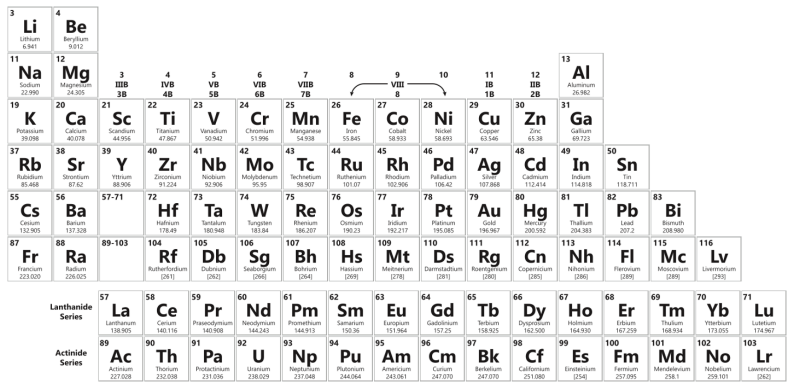
Metals also tend to lose electrons easily during chemical reactions, which explains much of their reactivity. The following figure shows the metals.
What are nonmetals in the periodic table?
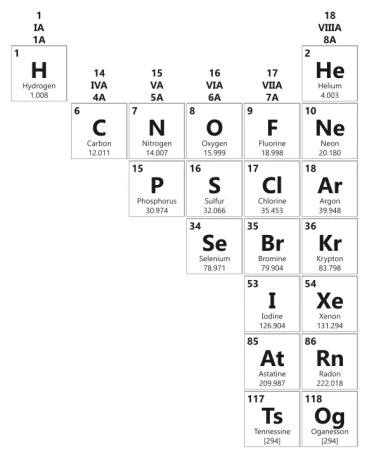
Nonmetals are the elements found to the right of the stair-stepped line (along with hydrogen), excluding the elements that border the line itself. Nonmetals have properties that are essentially the opposite of metals.
Where metals are ductile and malleable, nonmetals are brittle and break rather than bend. Nonmetals are also poor conductors of both heat and electricity, and they tend to gain electrons during chemical reactions rather than lose them. Some nonmetals exist as liquids, and others as gases, showing more variety in physical state than metals do. These elements are shown in the following figure.
What are metalloids in the periodic table?
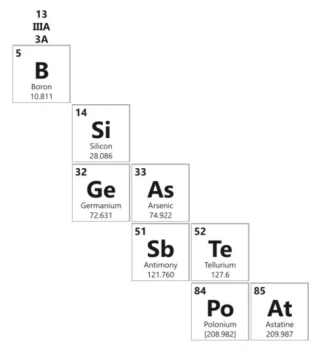
Metalloids, also called semimetals, are the elements that sit directly along the stair-stepped line dividing metals from nonmetals. As their in-between position suggests, metalloids have properties that blend characteristics of both metals and nonmetals.
Metalloids are especially important economically because of their unique conductivity: they only partially conduct electricity, a property known as semiconductivity. This makes metalloids like silicon essential to the semiconductor and computer chip industry that powers modern electronics. The metalloids are shown in the following illustration.
Frequently Asked Questions
How can you quickly tell if an element is a metal, nonmetal, or metalloid?
Find the stair-stepped line on the periodic table that runs from Boron to Polonium. Elements to the left are generally metals, elements to the right (plus hydrogen) are nonmetals, and elements bordering the line itself are metalloids.
Why do metals conduct electricity better than nonmetals?
Metals conduct electricity well because their atoms lose electrons easily, allowing those electrons to move freely and carry an electrical charge. Nonmetals tend to hold onto or gain electrons, which makes them poor conductors.
Are metalloids rare on the periodic table?
Metalloids are far less numerous than metals or nonmetals, since they only include the small handful of elements bordering the stair-stepped line, such as Boron, Silicon, and Germanium. Despite their small numbers, they play an outsized role in technology because of their semiconducting properties.
About This Article
This article can be found in the category:
Hot off the press
Explore Related content